Thursday, March 18, 2021

The Impact of Implicit Bias in the Classroom


from Colorlines & RaceForward

Educators, click the image above and take 7 minutes and 40 seconds to watch this video and listen to the voices of these young, black men talk about how they navigate implicit bias in the classroom.

*     *    *

This was recorded in 2014...

What has changed in your school/district since this was filmed? What remains the same?

My takeaways... kids want to be seen and heard for who they are rather than stereotyped or labeled... isn't that true of us all?

What can we do to be more aware of our own implicit bias and how it may impact our students so that we can ensure our students thrive?

I would love to see your reflections and takeaways in the comments below!


Monday, March 15, 2021

A Vision of Equity

When I was a young teenager, I remember my dad sitting me down to have a conversation about dating and marriage.  He explained that he was praying for me as I was about to embark on my dating journey, and that he and my mother were praying for my physical and emotional well-being during a time in my life that could be rather challenging.  

He also shared that they were praying for my future husband...that my life partner would be someone that I connected with phyiscally, emotionally, intellectually, and spirtually.  As I dated throughout my teenage and early college years, if a relationship seemed to be getting serious, he would sit down with the yourng man and explain his fatherly expectations: 

"If you're going to be in a serious relationship with my daughter and potentially marry her, my expectation is that your relationship supports each other physically, emotionally, intellectually, and spiritually." 

He would go on to explain that if one of these four areas is out-of-balance, that it would inevitably lead to problems in the relationship.  I found that to be 100% true as I navigated the rocky course of relationships that led to meeting and marrying my husband of now 14 years. 

My husband, Hamid & I, at the Baha'i Gardens in Haifa, Israel in April of 2019
 
Although I didn't know as an early teenager what exactly I wanted or needed in a life partner, through this conversation, my dad helped me to visualize the cornerstone attributes that are needed to sustain a healthy relationship.  My marriage is far from perfect and my husband and I have shared many struggles over the years, but I feel safe and secure in my relationship knowing that these four cornerstones have given us a strong foundation as we endure the trials and tribulations that most definitely come with the committment to "do life" together.

To my surprise, I came across these same four cornerstone attributes while reading and studying Glenn Singleton's book Courageous Conversations About Race: A Field Guide for Achieving Equity in Schools.  On p. 234-236 of his book, Glenn invites readers to visualize a school that is truly equitable.  He affirms that, in schools that are truly equitable, 

"children feel safe and secure...understanding that their physical, emotional, intellectual, and spirtual safety [are] at heart," (p. 234).


I would invite you to pick up a copy of Glenn's book and engage with a small group of colleagues in a book study around Courageous Conversations.  But before you all begin reading, turn to page 234 and read the section titled "A Vision of Equity".  In a couple of short pages, Glenn powerfully captures what a school experience could be for all our students if we all shared the same vision of equity.  Here are some highlights from p. 234-236:
  • Environment: clean, well-resourced, inviting (warm & welcoming), where all are treated with respect and dignity in classrooms that are proportionally represented
  • Educators: excited, capaple, steadfast teachers who, through collaboration blended with a high level of autonomy, expose students to rigorous, common viable core curriculum that is reflective of the diversity of the students; teachers push students to excel with high expectations and appropriate supports
  • Students: "know that the teacher's aim is to promote their mastery of subject matter" &"believe they will recieve every tool they need to succeed beyond the classroom," 
  • Leadership: driven by the needs of the teachers and students through collaboration and the encouragement of professional growth and development; present on campus "addressing school-related problems quickly, efficiently, and completely,"; leads the effort to connect with the community
  • Community: reciprocal partnership between the school and community in which families are "invited, encourged, and expected" to be involved; "Families know that their voice matters...feel ownership of the school, and they are affirmed as a vital part of student success." 
My short, paraphrased list doesn't nearly encompass all the greatness of Glenn's vision for equity, but I'm hoping that it peaks your interest enough to pick up this book!  

Some may say that his vision is "idyllic", but I believe that his vision is realistic and achieveable if we put the work in to make it happen.  Just like a marriage relationship, it will take work.  It must start with a vision of equity that all stakeholders can plainly see.  If we can visualize the cornerstones of a truly equitable school system, we can work towards making that vision a reality. We can build a foundation of equity in our public schools where all our students can thrive.  

Reflective question:  How can WE foster a school environment in which our students truly understand that the school has their physical, emotional, intellectual, and spiritual safety at heart?


Give Glenn Singleton a follow on Twittter @courageousdove and/or Instagram @courageousdove444 ðŸ•Š

If you're ready for tangible "next steps" to start doing the work in creating truly equitable schools, check out my blog post from November titled 8 Ways that Teachers can Help to Eradicate Inequity in Public Education!  #7 hits on today's post! 😉

Monday, February 8, 2021

Vocabulary Detective Google Slides Template

 I've seen so many "vocabulary detective" activities out there that I was inspired to make one! 


 The goal of this activity is to encourage students to expand their lexicons by intentionally looking and listening for new vocabulary words in their every day life - in movies or TV shows, commericals or print advertisements, etc.  When they "detect" one of the words on their list, they must document the "evidence" in the slide deck - where and when they saw/heard the word and in what context - as well as create an original sentence using the term with an image that symbolizes the meaning of the word.


Get your editable copy here: http://bit.ly/VocabDetect2021 


Friday, December 18, 2020

So, How is Distance Learning Really Going?


This week, my ELA TOSA partner, Cathy, and I were able to host a diverse panel of some of our secondary students to hear their perspective on how distance learning has been going this semester.  


Prior to the discussion, we surveyed the students via a Google Form to not only help them preprare their thoughts for the discussion, but to also give us a litte insight into how their experience has been so we could prepare how we would present questions to them during the live event.  

One of the first questions we asked them was to consider the reasons that prevent them from attending their virtual classes.  From their responses, it was evident that issues with their Internet access or their devices were the top reasons keeping them from having good attendance.  As part of the tech department with our district, I know that we've been working hard to get all our students connected with functional devices, but hearing from these kids let us know that there are still technology issues that need to be resolved so that all of our students can have a better online learning experience.  


During our discussion, we asked the students to elaborate more about the challenges they've experienced during distance learning.  


They noted some expected issues like not physically being there with the teacher and dealing with background noise and distractions in their home that they wouldn't normally experience in the brick-and-mortar classroom environment.  They also noted that, at times, learning at home feels stressful with the amount of digital assignments they're required to submit by their teachers and the anxiety they sometimes feel when they have to communicate on camera in synchronous sessions.  They were pretty outspoken about how they didn't appreciate that some teachers required them to turn on their cameras with a threat of their grades being reduced for refusing to do so. Some students noted, however, that teachers who encouraged them to use their camera as part of particular learning community activities were more likely to have participation from most or all of the students rather than those teachers who threatened with punitive measures.  

The students also expressed frustration that some teachers turn off the chat feature in synchronous sessions which, for some students, is the only way they have to communicate with the teacher or their peers.  This leads me to the biggest challenge that our students said they were facing: loneliness.  Over and over again, these kids reiterated that they were extremely lonely during distance learning.  Even when logging online with their peers, some are being given very little opportunity to interact with each other and just be kids.  In some scenarios, students stated that they're literally home alone all day because parents are working, so the feelings of isolation and loneliness are exacerbated.  This loneliness over time has caused more saddness and depression in our kiddos... To combat that loneliness, as teachers, we must consider how we can help our kids feel more connected and a part of our learning communities.  

On a positive note, the students responded that the thing that is the most motivating for them to attend and participate in online learning is the teachers!!!


The positive relationships that many teachers are building with students are absolutely necessary and meaningful to our kiddos.  Some kids are showing up online every day just because of their teachers!  Students specifically said in the panel discussion that they appreciated the compassion, understanding, and helpfulness they are getting from some of their teachers.  They expressed gratitude for the dedication of our teachers, how teachers are checking-in with them daily, and the patience that our teachers are showing as they explain concepts over and over again until kids grasp it!  Some students noted that they have even been able to foster closer relationships with their teachers than they normally do in the regular classroom environment.  One student said that teachers' positive attitudes are a "ray of sunshine" in her day.  

The big takeaway here is RELATIONSHIPS MATTER!  We must continue nurturing relationships with students by providing support and bringing joy to the online learning environment so our students can overcome the loneliness and isolation in order to THRIVE!  


Friday, November 13, 2020

8 Ways that Teachers can Help to Eradicate Inequity in Public Education

8 Ways that Teachers can Help to Eradicate Inequity within Public Education


As a teacher, nothing makes me happier than when I hear back from students in their adult life who are successfully following their dreams and passions.  And when I learn that they are going above and beyond that to make a positive impact by being a changemaker, that rocks my world!  

Meet Nia Slater-Bookhart, one of my former students that I taught in Florida at Bartels Middle School who is now a certified fellow educator with a Masters in Teaching!!!


"I am my ancestors' wildest dreams."


When Nia was my student, I remember her as a natural leader among her peers. She could've easily been a class clown with her sense of humor; but I recall that she had a keen awareness of when was the appropriate time to joke around and when was the time to focus, listen, and speak with respect.  She was very well-spoken for her age, and she stood out as one of the stronger adolescent writers among her peers in my English classes.  I knew back then that this girl had a voice, and that one day she would use it in a big way.  

After graduating high school, Nia attended Clark University and earned her Bachelor's Degree in History in Community, Youth, and Education Studies as well as her Masters in Teaching.  Here are some of Nia's words from her graduation post on her Facebook page:
"The journey to getting my Masters in Teaching was definitely many leaps and hurdles... It was a hard year in many ways, especially when I came to terms with the many issues that our education system has, but also what it meant to be a Black educator in a system that wasn’t made for you/people that look like you. But that became one of the many reasons I wanted to be a teacher. ... Now a year later and a newly licensed Social Studies Teacher, I am so excited to create a classroom where my students feel empowered to learn the truths of our world histories through different/marginalized perspectives, but also to appreciate the understanding of our past so we can move toward a better future. More importantly, my hope is to teach all my future students to lead with empathy and kindness in all they do and to share that with the world, because it is so needed."

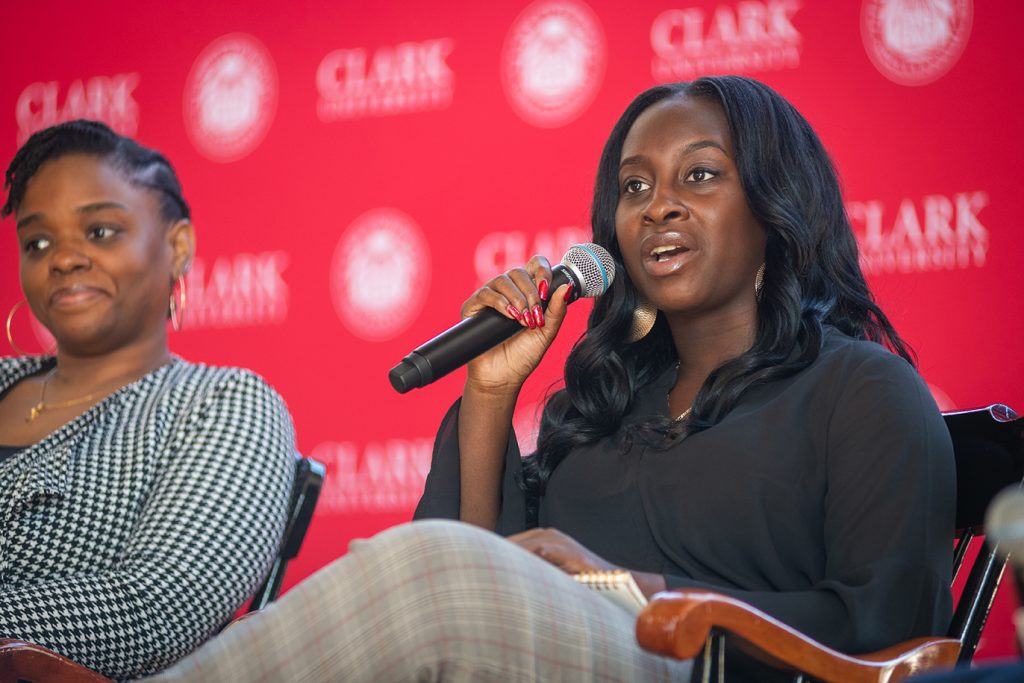
During Black History Month in February of 2020, prior to the impact of the COVID-10 pandemic, Nia was invited to be a part of a panel for an event in honor of the legacy of Martin Luther King, Jr. As a panelist, she discussed inequity and inequality in K-12 education and the challenges of educational equity in our schools today which includes, but is not limited to, a lack of understanding/consideration of minority cultures, (Luttrell).  

2020 Martin Luther King Day event at Clark University


During the panel discussion, Nia recounted that from her experience in public schools, she was not introduced to a single piece of literature written by a person of color until her senior year of high school (Luttrell).  When I learned of this, a pang of shame overcame me, and I had to admit to myself that when I was her teacher, at the time, planning my lessons through a lens of equity or diversity was not on my radar, and I did not (that I recall) teach a novel that was authored by a person of color.  This was absolutely unintentional on my part; as a relatively new teacher, when selecting a novel to teach, I probably chose a book that: 

      1) the library was sure to have a class set of 
      2) that I had read before and was comfortable with teaching
      3) I thought would be engaging for most students and/or 
      4) was required by the curriculum.  

We probably read something like "The Outsiders" by S.E. Hinton (which is a book I absolutely loved teaching and that most students loved reading, based on their feedback); but honestly, it's been so long, I can't recall what novel we read the year I had Nia.  (After speaking with Nia during the drafting process of this post, I learned that she read the novel Tangerine under my instruction, which was the novel that was required by the newly adopted SpringBoard curriculum that our district purchased at the time.) Nonetheless, my point is that for a long time, I didn't intentionally think about selecting a novel (or other literature pieces) through a lens of cultural relevance for my students.  I don't think my heart was in the wrong place as I loved all my students dearly and I genuinely was trying to make learning purposeful in order to help my students achieve as much as possible while they were in my classroom; but not planning my instruction through the lens of cultural relevance was, like the panelists discussed, a lack of understanding on my part of the needs of my students of color.  

It is so important for teachers, especially white teachers who are the majority in our field, to confront the biases that we may not even realize exist within ourselves in order to change the educational experiences of our students of color.  

“Once educators are freed from defensiveness and realize that no one is questioning their intentions, they can engage in the daily work necessary to ensure students of color are consistently treated fairly and with respect, high expectations, and dignity,” (Benson & Fiarman).

We must acknowledge that there are "disparities in meaningful educational opportunities that give rise to the achievement gap," and that the racism that exists in the public school system plays a large part in creating those gaps (U.S. Dept. of Ed.).  I recently came across edgap.org which is a powerful mapping tool that can help viewers "see" the educational and opportunity gaps in education based on low/high income areas.  Another source worth exploring is opportunityatlas.org which shows which neighborhoods in America offer children the best chance to rise out of poverty.  

To close these gaps, it is a moral imperative that we provide equitable, meaningful learning experiences to our students of color that will fuel their desire to achieve.  Not only is this imperative for each individual child's overall well-being and educational success, but it is imperative for our national economy to thrive and for non-white American graduates to be able to compete in the global workforce.  According to the U.S. Department of Education, economists have estimated that if we can achieve a "90% graduation rate for students of color," it would add approximately "$6.6 billion in annual earnings to the American economy," (U.S. Dept. of Ed.)!  Can you imagine that?!  

So, how can we, at the teacher level, do our part to help eradicate inequities within public education?  


1. Educate ourselves - although we are educators, we don't know it all!  (to start, I would suggest watching 13th and Teach Us All on Netflix and reading Post-Traumatic Slave Syndrome by Dr. Joy DeGruy or The New Jim Crow by Michelle Alexander). Be a lifelong-learner beyond the content you are assigned to teach.  Seek to truly understand the past and how BIPOC's (Black, Indigenous, People of Color) lives have been impacted because of it.

2. Truly listen to people of color, especially our students and colleagues, and believe them when they share their experiences with racism (Singleton, p. 5). In the classroom, this means cultivating a "community where students feel comfortable having difficult conversations" and expressing themselves in a safe space (Wertheimer). Conversations about race, racism, bias, stereotypes, etc. can be woven into nearly every subject when appropriate.  “This work is uncomfortable and that’s not something that people really want to step into,” Nia noted in a recent conversation when discussing how to navigate difficult conversations with colleagues and students.  But this work is absolutely necessary to profoundly understand the catastrophic impact of racism, inequities, and inequality and to do the work needed to achieve true educational equity. 


3. Confront our own internalized biases and sociopolitical consciousness that may influence interactions and impact on students.  This includes taking the time to explore and recognize your own racial, cultural, and ethnic identities and the perceived societal stereotypes that may come with that identity and owning your mistakes when you make them (Wertheimer).  Honestly reflect:  Are my words and actions potentially excluding or evening harming people of color OR am I including and helping marginalized groups?  Take the advice of Rosa Isaiah and start transitioning your mindset from color-blind to color-brave (Isaiah).


4. Be an empathetic ally by recognizing racist discriminatory practices and speaking out against it.  We tell our students all the time in "bullying" situations to not be a bystander - we shouldn't be bystanders either.  When we don't oppose racism, we enable it.  We need to be anti-racist in any and every situation that calls for it by raising awareness and advocating for equity.  Looking for more resources for Social Justice and Equity?  Check out this collection from Common Sense Media!

5.  In the four walls of our classrooms, make learning meaningful and culturally relevant for our students.  Expose students to the experiences (triumphs and tragedies) of people from a variety of cultures and ethnicities, especially those of African Americans by affirming Black lives in schools - and this includes not glossing over or downplaying the crimes against humanity that were committed by our white ancestors.  Check out this Affirming Black Lives Bookshelf of a few curated resources that could get you started (links to more resources are in the notes of the slides).


6.  Become a high-quality equitable educator because our students deserve for us to be at the top of our game!  Read the professional development articles and books, view the webinars and videos, attend the trainings and conferences - never stop learning and growing for the sake of your professional self and your students! 

7.  Be a part of helping to create a schoolwide culture by enriching coversations that promote true educational equity and excellence.  A good place to start with this work is with the book Courageous Conversations About Race: A Field Guide for Achieving Equity in Schools. A quote from the forward of this book: “Courageous Conversations helps us to be better educated, and that is exactly what every educator should want...[so this book] is a perfect place to begin,” (Singleton, xvi).


8. Take action, vote, and support policies/measures that promote equity in education.  For example, start by supporting the Emergency Educational Connections Act (which is now known as the Homework Gap provisions of Heroes Act 2.0 - HR 925, S.3362).  The COVID Pandemic has shone a spotlight on long-standing inequities in our public educational system. A major inequity is the lack of internet access at home for as many as 16 million students. "The Emergency Educational Connections Act provides at least $4 billion for a one-time emergency fund, administered by the Federal Communications Commission’s E-Rate program, to equip students with hot spots and devices for distance learning." Supporting this measure will help give ALL our kids access to online public educational services during the pandemic so that the opportunity and achievement gaps do not continue to widen. #connectallstudents - Check out where your state stands in the Digital Divide.

***And as a side note to this last one, I'm very proud to say that the school district I work for (Hemet Unfied School District) made getting students access to devices and internet a priority, and now 100% of our students are equipped and connected which has helped to close the digital divide for our students. There is still work being done in upgrading some devices and strengthening internet connections in outlying areas so that students' overall experience in online distance learning will be better, but I'm happy that we have a CTO who is making this type of work a priority. If you're reading this and you work for a different district, one way you can advocate is to contact your district's leadership and ask "Do 100% of our students have access to devices and internet? If not, what steps are we taking to make this happen?"

This is not a comprehensive list; I'm sure there are more steps we can take as individual teachers to help eliminate inequities in education, but these eight suggestions are a good place to start.  Please feel free to comment with other ideas and resources that may help us to eradicate inequities in public education.  

And to my former student Nia, thank you for being the beautiful person that you are, both inside and out, and inspiring me to write this piece.  I will be following your journey as an educator and advocate for equity from across the country!  


Sources:

Benson, Tracey & Fiarman, Sarah. "The Reality of Unconscious Racial Bias” in School Administrator, February 2020 (Vol. 77, #2, pp. 20-25), https://bit.ly/31XxxjU

Isaiah, Rosa. "The Leadership Journey From Color-Blind To Color-Brave ". Ascd.Org, 2020, http://www.ascd.org/publications/newsletters/education_update/nov20/vol62/num11/The_Leadership_Journey_from_Color-Blind_to_Color-Brave.aspx. Accessed 30 Nov 2020.


Singleton, Glenn E. Courageous Conversations About Race: A Field Guide for Achieving Equity in Schools. 2nd ed., Thousand Oaks, Corwin, 2015.

U.S. Department of Education, For Each and Every Child—A Strategy for Education Equity and Excellence, Washington, D.C., 2013. https://www2.ed.gov/about/bdscomm/list/eec/equity-excellence-commission-report.pdf

Wertheimer, Linda K. "Tips For Teaching About Racism - The Boston Globe". Bostonglobe.Com, 2020, https://www.bostonglobe.com/2020/08/28/opinion/tips-teaching-about-racism/. Accessed 1 Sept 2020


Thursday, September 17, 2020

Google Slides Editable Virtual Invitations Templates


Today my EdTech partner, Terri, and I were able to do a short training with some counselors in our district on some best practices for connecting with students virtually during these crazy times we're in.  Anything we can do to maintain that "human connection" with our students is so incredibly important right now.  During my portion of our training, I offered some strategies for connecting with students synchronously.  

One of the strategies that I spoke about about was utilizing Google Slides to create visually appealing "evites" to encourage students to connect.  Creating a virtual invitations is a simple way that you (as a teacher, counselor, administrator, librarian, etc.) can try to motivate students to engage synchronously. In your catchy virtual invitation, provide the Google Meet link and information about the online gathering.  Then, send it via email or post in a Google Classroom for groups of students.  

Get your free editable copy of my example invitations here --> http://bit.ly/Virtual_Invitations  You'll just need to delete my Bitmoji, add your own, and the change the information to suit your needs.  I would encourage you to add another blank slide at the end, get creative, and design your own!  If you do create some catchy Google Slides evites, and you're willing to share with others, provide a shareable link in the comments! #bettertogether

Saturday, August 22, 2020

Snack Shack Google Slides Template

 Click the GIF below for your own editable copy of my

 ðŸ‘‡"Snack Shack" Student Voice & Choice Template! ðŸ‘‡


This week was our first week back to school in this new virtual world we're living in.  I know it's been a tough week (errr...month...errr...YEAR - what the heck, 2020?! ðŸ˜²).  So to spread some positivity and hopefully put a smile on your face, here's a FREE Google Slides template that I hope will spark inspiration for some creative lesson ideas!  

We've visited the beach a lot this summer to get the kids out of the house during the pandemic; and of course, when we visit the beach, snacks are a must!  So as you can see, the beach scenery and my love of snack food are what inspired me to create this template. 😉 

I have provided a copy of the Google Slides template for you to edit/customize as you see fit for the grade level/content that you teach.  You'll need to delete my Bitmojis and replace them with your own, and provide the actual instructional content/activities to the slides.  Because this template is such a blank slate, it really could be used with variety of content in virtually any grade level.  You can insert audio files, videos, links to resources/materials, etc. ~ the possibilities for what you could do with this template really are endless!  More detailed instructions and tips for use can be found within the presentation in the bright yellow boxes (which you should delete before actually sharing with students).  

I'm eager to see your creations, so if you personalize my template and create something "sweet and savory," please share your creation on this Snack Shack Padlet for the world to see!  Happy creative lesson planning!!! ðŸ¤—